Tankworld Trade -
16 December 2025
Pump Selection Guide for New Builds
How Builders Can Choose the Right Water Pump for Every Project
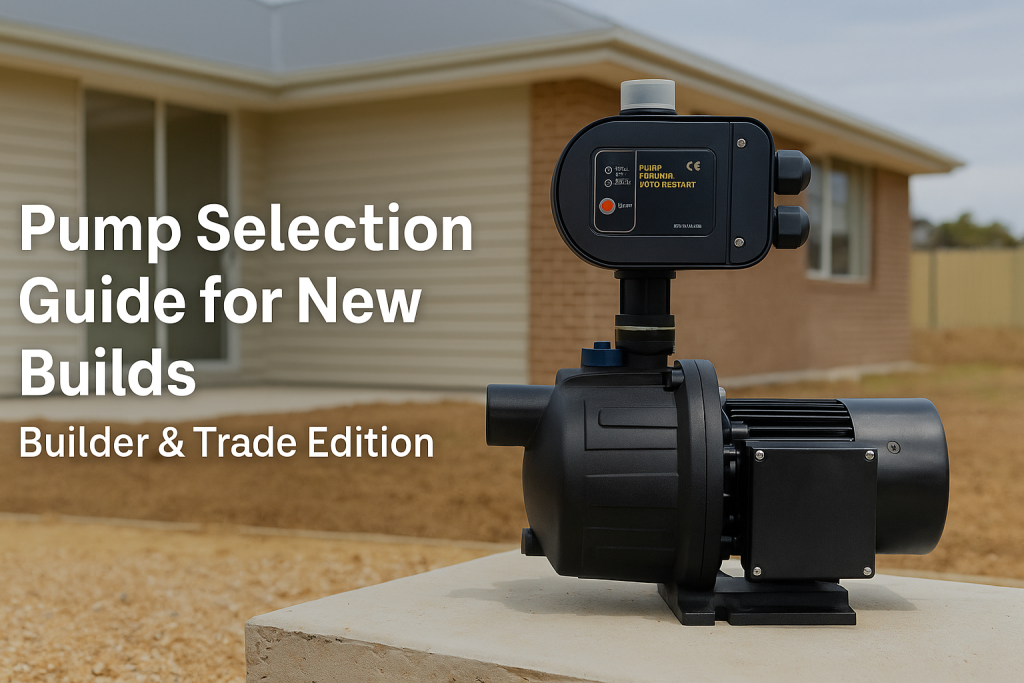
Selecting the right water pump is a critical part of any new build.
This Pump Selection Guide helps builders, plumbers and trade professionals choose the correct pump early in the project to avoid pressure issues, compliance problems and costly upgrades later.
Pump selection affects water pressure, system reliability and long-term client satisfaction. When it is planned properly during the design and construction phase, the entire water system performs better from day one.
This guide is written for trade professionals working on suburban homes, rural properties and bushfire-prone builds across Australia.
Why Pump Selection Matters in New Builds
Incorrect pump selection often leads to problems after handover, including:
- Poor water pressure complaints after handover
- Noise issues inside the home
- Insufficient flow to fixtures and appliances
- Expensive upgrades once the home is occupied
Choosing the right pump early helps ensure the system matches:
- The home’s water demand
- Tank size and location
- Distance and elevation changes
- Planned indoor and outdoor use
Pump Types Commonly Used in New Builds
This Pump Selection Guide covers the four pump types most commonly specified by builders and plumbers.
1. Household Pressure Pump
Household pressure pumps are the most common choice for residential new builds that use rainwater inside the home.
Best suited for:
- Toilets and laundry
- Bathrooms and taps
- Single to medium-sized homes
Trade notes:
- Automatic start and stop
- Consistent pressure for normal household demand
- Reliable option where water use is predictable
Tank pairing:
👉 Pump Recommendation:
2. Rainwater to Mains Changeover Pump
Rainwater-to-mains changeover systems automatically switch to mains water when tank levels are low.
Best suited for:
- Urban and suburban new builds
- Homes requiring an uninterrupted water supply
- Projects with council or BASIX-style requirements
Trade notes:
- Must be planned during plumbing rough-in
- Reduces homeowner involvement
- Ensures fixtures remain operational year-round
Tank pairing:
- Typically paired with slimline or round tanks
- Tank size selected based on roof catchment and intended internal use
👉 Pump Recommendation:
-
Sale
Product on sale
Rainsaver MK4E and BIA-INOX60S2MPCX
$935.00
$1,100.00
$935.00
$1,100.00
$935.00
$1,100.00
-
Sale
Product on sale
Rainsaver MK4e Pump Controller and BIA-AUTOSUB
$1,265.00
$1,485.00
$1,265.00
$1,485.00
$1,265.00
$1,485.00
-
Sale
Product on sale
Rainsaver MK4E and DAB-JETCOM82NXT
$1,125.00
$1,320.00
$1,125.00
$1,320.00
$1,125.00
$1,320.00
-
Sale
Product on sale
Rainsavers MK4E and DIVERTRON900
$1,495.00
$1,760.00
$1,495.00
$1,760.00
$1,495.00
$1,760.00
3. Variable Speed Constant Pressure Pump
Variable-speed constant-pressure pumps are a premium solution for new builds that require stable pressure across multiple fixtures.
Unlike standard pressure pumps, these systems adjust output automatically to match demand, maintaining constant pressure even when multiple taps or appliances are in use.
Best suited for:
- Large homes
- Multi-bathroom builds
- High-end residential projects
- Homes with fluctuating water demand
Trade notes:
- Reduced pressure fluctuation
- Quieter operation
- Improved energy efficiency
- Lower wear on plumbing components
Tank pairing:
- Best paired with larger round tanks or multiple tank setups
- Tank sizing should allow sustained flow without a pressure drop
- Ideal where tank water supplies the entire home
👉 Pump Recommendation:
-
Sale
Product on sale
DAB- Esybox
$2,945.00
$3,465.00
$2,945.00
$3,465.00
$2,945.00
$3,465.00
-
Sale
Product on sale
DAB- Esybox Mini3
$1,730.00
$2,035.00
$1,730.00
$2,035.00
$1,730.00
$2,035.00
4. Firefighting Pump 🔥
Firefighting pumps are specified for rural, semi-rural and bushfire-prone new builds.
These pumps deliver high pressure and high flow for emergency response and are not designed for daily household use.
Best suited for:
- Bushfire-prone sites
- Acreage properties
- Homes with perimeter or rooftop sprinkler systems
Trade notes:
- Often petrol-powered for reliability during outages
- Installed as a separate system from the household supply
- Requires clear access and dedicated fittings
Tank pairing:
- Should be connected to a dedicated firefighting water tank
- Commonly 10,000L or larger
- The tank should remain full and clearly identified
👉 Pump Recommendation:
-
Sale
Product on sale
BIA-MH215SHP – Bianco Vulcan Engine Driven Fire Pump – Powered by Honda GX200
$2,200.00
$2,750.00
$2,200.00
$2,750.00
$2,200.00
$2,750.00
-
Sale
Product on sale
BIA-2HP15ABS – Bianco Vulcan 6.5HP Twin Stage Briggs & Stratton Engine Driven Fire Pump
$1,540.00
$1,925.00
$1,540.00
$1,925.00
$1,540.00
$1,925.00
-
Sale
Product on sale
BIA-FFHK – FIRE FIGHTING HOSE KIT
$375.00
$420.00
$375.00
$420.00
$375.00
$420.00
-
Sale
Product on sale
BIA-MH15SHP – Bianco Vulcan Engine Driven Fire Pump – Powered by Honda GX160
$1,760.00
$2,200.00
$1,760.00
$2,200.00
$1,760.00
$2,200.00
Builder-Only Pump Comparison Table
| Pump Type | Typical Use in New Builds | Builder / Plumber Notes | Recommended Tank Pairing |
| Household Pressure Pump | Toilets, laundry, bathrooms, taps | Standard residential pump. Quiet, automatic operation. Size pump to the number of bathrooms and fixtures. | Slimline or round tanks (2,000L–10,000L+) |
| Rainwater to Mains Changeover Pump | Internal supply with automatic mains backup | Common for urban builds and compliance. Must be planned during rough-in. | Slimline or round tanks sized to the roof catchment |
| Variable Speed Constant Pressure Pump | Large homes, multi-bathroom builds, high-end projects | Maintains constant pressure across multiple fixtures. Quieter, more efficient. Premium solution. | Larger round tanks or multiple tank setups |
| Firefighting Pump | Bushfire-prone or rural properties | Emergency use only. High pressure and flow. Often petrol-powered. Must be separate from household supply. | Dedicated firefighting tank (10,000L+) |
Planning the Complete System (Pump + Tank)
For builders, pump selection should never be done in isolation. System performance depends on:
- Tank size and outlet height
- Distance from tank to dwelling
- Hose length and elevation
- Fixture demand and simultaneous use
Common builder setups include:
- Household pressure pump + round tank
- Changeover pump + slimline tank
- Variable speed pump + large round tank
- Household pump + firefighting pump + dedicated fire tank
Early planning avoids compliance issues and post-handover upgrades. Many projects benefit from a dual-pump setup, separating daily household use from firefighting or high-demand applications.
👉 Choose the right Water Tank + Pump Package
-
Sale
Product on sale
2,000L Slimline SLR Tank and TANKWORLD 45 Pump
$1,214.00 – $1,324.00
$1,214.00 – $1,324.00
$1,289.00 – $1,399.00
-
Sale
Product on sale
2 x 23,650L Round Corrugated Tank and TANKWORLD 45 Pump
$5,739.00 – $6,289.00
$5,739.00 – $6,289.00
$6,189.00 – $6,739.00
-
Sale
Product on sale
5,000L Slimline SLR Tank and TANKWORLD 45 Pump
$2,089.00 – $2,254.00
$2,089.00 – $2,254.00
$2,089.00 – $2,254.00
-
Sale
Product on sale
23,650L Round Corrugated Tank and TANKWORLD 45 Pump
$3,044.00 – $3,319.00
$3,044.00 – $3,319.00
$3,269.00 – $3,544.00
📍 Installation & Access Considerations
When specifying pumps in a new build:
- Allow clear access for servicing
- Use pump covers for weather and noise protection
- Position pumps away from bedrooms where possible
- Ensure compliant fittings for firefighting use
Correct placement reduces callbacks and improves long-term reliability.
BAL / Bushfire 🔥 Compliance Notes (Trade)
For BAL-rated or bushfire-prone sites:
- Dedicated firefighting water storage is strongly recommended
- Minimum water volumes are often expected by councils
- Firefighting pumps should not share a household supply
- Petrol-powered pumps provide reliability during outages
Always confirm site-specific requirements early in the build process.
State-Based Compliance Notes (Trade)
🔴 Victoria (VIC)
- BAL-rated sites may require a dedicated firefighting water supply
- CFA commonly recommends a minimum of 10,000L available for fire protection
- Firefighting pumps should be independent of the household supply
- Clear access to tanks and pumps is essential
🔵 New South Wales (NSW)
- RFS guidelines often apply in bushfire-prone areas
- Dual-pump systems are common on rural builds
- Firefighting pumps should support long hose runs and sprinkler systems
- Confirm local council requirements early
🟢 South Australia (SA)
- CFS bushfire planning guidelines apply
- Dedicated water storage and pump systems are strongly recommended
- Pumps must be accessible and clearly identified
- Petrol-powered fire pumps preferred for outage reliability
⚠ Always confirm site-specific council and BAL requirements during design.
👉 Find out: How to Prepare Property With the Right Water Storage for Bushfire Season 2026🔥
🤝 Trade Support – Get the Right System Specified Early
Tankworld Trade supports builders, plumbers and developers by helping specify the right pump and tank combination for each project.
Our team can assist with:
- Pump selection based on site conditions
- Tank sizing for household and firefighting use
- Trade pricing and supply coordination
- Reducing post-handover issues
👉 Speak with a Tankworld Trade specialist
Builder & Trade FAQs
1. When should pump selection be finalised in a new build? Pump selection should be confirmed during the design or early construction phase, ideally before plumbing rough-in. Early selection ensures correct pipe sizing, power provision, and pump location, which helps to avoid costly changes after handover.
2. Can one pump handle both household use and firefighting? In most cases, no. Best practice is to install two separate pumps:
– A household pressure pump for daily use
– A dedicated firefighting pump reserved for emergency response
This ensures household demand does not reduce pressure or flow during a fire event.
3. Do builders need to install a rainwater to mains changeover system? For many urban and suburban new builds, yes. Rainwater to mains changeover pumps help meet council, BASIX and planning requirements while providing an uninterrupted water supply to the home.
4. What pump type is best for multi-bathroom homes? Homes with two or more bathrooms generally require a higher-capacity household pressure pump capable of maintaining consistent pressure across multiple fixtures running at the same time.
5. Are firefighting pumps mandatory in bushfire-prone areas? Requirements vary by council and BAL rating. While not always mandatory, firefighting pumps and dedicated water storage are strongly recommended and often expected on rural or BAL-rated sites.
6. Should firefighting water be stored in a separate tank? Yes. Many builders specify a dedicated firefighting tank to ensure water availability regardless of household usage.
7. What power supply considerations are needed for pumps? Builders should allow for:
– Weather-protected power outlets
– Adequate ventilation
– Petrol-powered fire pumps where power reliability is a concern
About the Author
Written by Diana Tika Lestari, Content and Marketing Specialist for Tankworld Group.
Diana Tika Lestari is an experienced content and digital marketing specialist who focuses on helping Australians understand water storage, household plumbing systems and sustainable building practices. With a strong background in SEO, content strategy and consumer education, Diana writes clear and practical guides that support homeowners, builders and trades in making confident decisions for new builds and renovations.
Her work blends technical accuracy with a friendly, easy-to-follow tone that reflects Tankworld’s commitment to helpful and trustworthy advice.