Blog -
14 January 2026
Why Is Australian Weather So Unpredictable?
Understanding Australia’s climate whiplash, extreme weather and rainfall patterns.
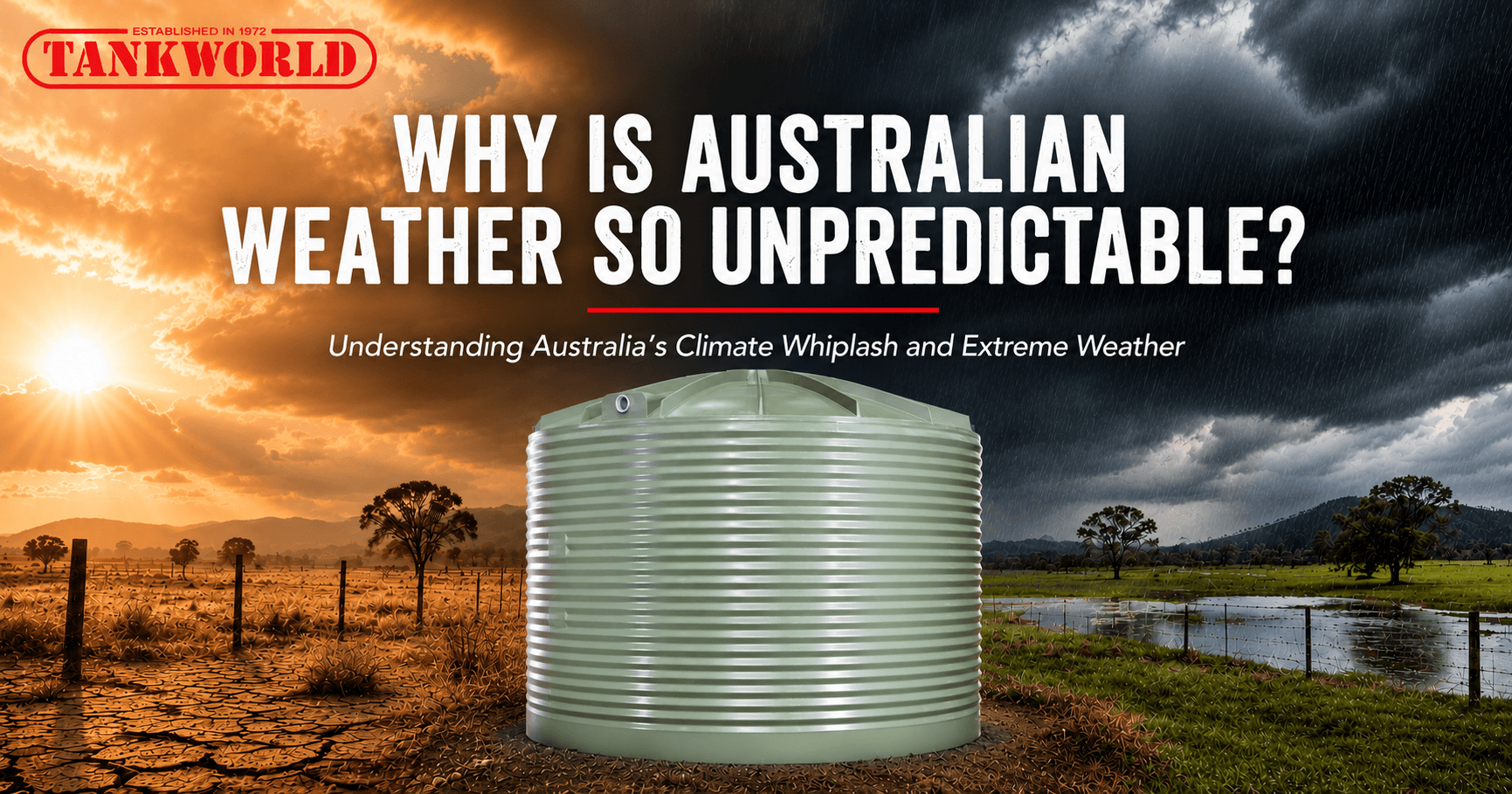
One Year You’re Waiting for Rain. The Next You’re Wondering When It Will Stop.
Ask almost any Australian farmer, and you’ll hear a familiar story.
One year the dams barely fill, paddocks turn brown, and every forecast is checked for signs of rain. The next, creeks overflow, roads are cut, and more water falls in a few days than the previous season delivered in months.
Builders experience it differently. A dry construction site can suddenly become inaccessible after heavy rain, delaying projects and creating new challenges for managing stormwater and water supply.
Homeowners notice it too. Gardens dry out during long hot summers, only to be followed by intense storms that send thousands of litres of rain straight down the driveway instead of into storage.
Australia has always been a land of weather extremes, but many people are now noticing that these swings occur more often and with greater intensity.
This rapid movement between prolonged dry conditions and heavy rainfall is often described as climate whiplash.
It doesn’t mean Australia’s weather is random. It means several powerful climate systems are constantly influencing different parts of the country, often simultaneously.
Understanding how those systems work helps explain why one region can be dealing with drought while another experiences flooding, and why planning for Australia’s weather has never been as simple as relying on average rainfall.
At Tankworld, We’ve Seen These Cycles for Decades
Since 1972, Tankworld has manufactured Australian-made water tanks for homes, farms and businesses across New South Wales, Victoria and South Australia.
Over that time, we’ve worked with customers through prolonged droughts, major flood events, bushfire seasons and everything in between.
One lesson has remained remarkably consistent. People rarely regret installing a water tank after a wet season. More often than not, they wish they had installed one before the dry season arrived.
That’s because Australia’s rainfall has never followed a predictable schedule. The years may change, but the challenge remains the same. When the rain comes, you need to be ready to capture it.
Whether you’re collecting rainwater for livestock, irrigation, a building project or household use, understanding Australia’s weather is the first step towards making smarter long-term water decisions.
What You’ll Learn in This Guide
In this article, we’ll explain:
Why Is Australia’s Weather So Unpredictable?
Australia’s weather is shaped by several powerful influences operating simultaneously.
The continent stretches from the tropics in the north to temperate and alpine regions in the south. It is surrounded by the Pacific, Indian and Southern oceans, while the vast interior can generate intense heat and strong pressure differences.
These features help explain why conditions can change so quickly and why one part of Australia can be flooding while another remains hot and dry.
Australia’s weather is erratic, but it is not random.
Australia Is a Continent of Extremes
Australia covers almost 7.7 million square kilometres and includes tropical, desert, Mediterranean, temperate and alpine climate zones.
No single weather system affects the whole country in the same way.
Northern Australia may be moving towards the tropical wet season while southern regions are experiencing cold fronts, frost and below-average rainfall. Inland districts can remain dry while coastal areas receive heavy rainfall from storms or low-pressure systems.
This is why national weather headlines can sometimes seem contradictory.
Reports of flooding in one state and drought in another can both be accurate at the same time.
Australia Sits Between Three Oceans
Australia’s location between three major oceans strongly influences rainfall and temperature.
The Pacific Ocean affects weather across eastern Australia and plays an important role in El Niño and La Niña.
The Indian Ocean influences rainfall across western and southern Australia, particularly through the Indian Ocean Dipole.
The Southern Ocean sends cold fronts and westerly winds across southern parts of the country, especially during the cooler months.
Ocean temperatures are constantly changing. When several surrounding ocean patterns shift at once, the effect on Australian weather becomes more complex.
One region may receive additional moisture while another becomes drier.
The Interior Can Intensify Weather Conditions
Australia’s inland areas heat quickly, particularly during spring and summer.
This heat can create big differences in atmospheric pressure between the interior and the cooler surrounding oceans. Those pressure differences influence wind direction, moisture movement and the development of weather systems.
Hot, dry inland air can contribute to:
- heatwaves
- low humidity
- increased fire weather
- rapid temperature changes
- severe thunderstorms when it meets moist air
This helps explain why temperatures can rise sharply ahead of a cool change or why one district receives a major storm while another nearby property records very little rain.
Why Australia’s weather changes so dramatically from year to year
Australia’s weather is influenced by several large-scale climate systems that interact rather than act independently.
Some of the best known include:
- El Niño and La Niña
- the Indian Ocean Dipole
- the Southern Annular Mode
- tropical cyclones and monsoonal systems
- ocean temperatures around Australia
- high and low pressure systems
- local geography and mountain ranges
These influences do not follow a fixed schedule, and they do not always push conditions in the same direction.
One climate driver may favour drier conditions across eastern Australia, while another may increase the chance of rainfall across southern regions.
That is why seasonal outlooks are based on probabilities rather than guarantees.
For a more detailed explanation of one of Australia’s best-known climate cycles, read our guide to El Niño and La Niña in Australia.
Why One Part of Australia Can Flood While Another Stays Dry
Australia’s size and regional climate zones allow very different conditions to occur at the same time.
Southern Australia
Parts of Victoria, South Australia, Tasmania and south-west Western Australia rely heavily on rainfall from cold fronts and other cooler-season weather systems.
Changes in the position and frequency of these systems can significantly affect winter and spring rainfall.
Eastern Australia
New South Wales and Queensland can experience prolonged dry periods interrupted by severe thunderstorms, coastal lows and intense rainfall.
Inland districts may remain dry while coastal areas receive flooding rain during the same weather event.
Northern Australia
Northern Australia has distinct wet and dry seasons.
Much of its annual rainfall arrives during the warmer months through monsoonal systems, thunderstorms and tropical cyclones. The dry season can bring very little rainfall for months.
Western Australia
Western Australia spans tropical, arid and Mediterranean climates.
The north can experience tropical cyclones and heavy seasonal rainfall, while the south-west has a very different rainfall pattern and depends more heavily on cooler-season weather systems.
These regional differences mean there is no single Australian weather pattern.
The same national climate driver can produce very different effects depending on the season and location.
Why Average Rainfall Does Not Tell the Whole Story
Average rainfall is useful, but it does not explain when rain will arrive or how it will fall.
A property may receive close to its annual average through a small number of heavy events, followed by long periods without meaningful rainfall.
Average figures do not tell you:
- whether rain will fall evenly throughout the year
- how long the gaps between rainfall events may be
- whether the rain will arrive slowly or in a short downpour
- how much water can be captured before storage is full
- whether the next season will resemble the previous one
For farmers, builders, rural property owners and households, timing can matter just as much as the total rainfall.
That is why practical water planning should account for both long dry periods and sudden heavy rain.
Climate Whiplash and Australia’s Recent Weather Extremes
Australia has always experienced drought, floods, heatwaves, bushfires and severe storms.
What stands out is how quickly conditions can shift from one extreme to another.
A long dry period can be followed by widespread rainfall. Saturated catchments can then make further rain more damaging. Heat and drought can increase bushfire risk, while a later shift in ocean and atmospheric conditions can bring major flooding.
This rapid movement between contrasting conditions is often described as climate whiplash.
What Is Climate Whiplash?
Climate whiplash refers to a rapid or dramatic shift between opposing weather conditions.
Examples include:
- drought followed by flooding rain
- prolonged wet conditions followed by a sharp dry period
- severe heat followed by a strong cold change
- repeated shifts between dry and wet seasons
The term does not mean Australia’s weather is completely unpredictable.
Many of the broad climate drivers are well understood. The difficulty is that their timing, strength and interaction can vary, and local weather systems can still produce unexpected results.
Climate whiplash is therefore a useful way to describe the impact of rapidly moving between extremes, particularly for communities trying to plan for water, agriculture, construction, or emergency response.
From Drought and Bushfire to Flooding Rain
One of the clearest recent examples occurred across eastern Australia.
Large areas experienced severe drought between 2017 and 2019. Low rainfall affected farms, dams, rivers, soil moisture and town water supplies.
Those dry conditions contributed to the extreme fire weather experienced during the 2019–20 Black Summer bushfires.
Conditions then shifted.
Successive wet periods and La Niña events contributed to major rainfall and flooding across parts of Queensland, New South Wales, Victoria and inland Australia between 2020 and 2022.
Some communities moved from severe drought and fire risk to repeated flooding within only a few years.
For farmers, builders and property owners, this is the practical reality of climate whiplash. Planning for only drought or only heavy rain may not be enough.
Why Heavy Rain After Drought Can Cause New Problems
Heavy rainfall after a dry period is not always immediately beneficial.
Very dry or compacted soil may not absorb water efficiently. Water can run across the surface, causing erosion and carrying soil, debris and contaminants into waterways.
Rain falling on already saturated catchments creates a different problem.
When the ground, dams and rivers are already full, even moderate additional rainfall can contribute to flooding.
The effect of a rainfall event depends on:
- how quickly the rain falls
- how long it continues
- the condition of the soil
- existing dam and river levels
- the amount of vegetation cover
- local drainage and terrain
Rainfall totals alone do not explain the full impact.
Is Australia’s Extreme Weather Becoming Worse?
Australia has always experienced extreme weather, but long-term observations show that some important background conditions are changing.
The Bureau of Meteorology and CSIRO report that Australia has warmed since national records began. Parts of southern Australia have also experienced declines in cooler-season rainfall, while heavy short-duration rainfall events are becoming more intense in some regions.
This can create conditions in which a region becomes drier over the long term yet still experiences severe individual downpours.
That may sound contradictory, but it reflects the difference between:
- how much rain falls over a season
- how intense a single rainfall event becomes
A region can receive fewer regular rainfall events while still experiencing intense storms.
For water planning, this means a good annual rainfall total does not always translate into a reliable supply throughout the year.
Australia’s Rainfall Outlook for August to October 2026
The Bureau of Meteorology’s rainfall outlook, issued on 9 July 2026, provides a current example of Australia experiencing opposing conditions simultaneously.
For August to October 2026, below-average rainfall is likely across much of the south-west and east, while parts of north-west and inland Australia have an increased likelihood of above-average rainfall.
The outlook indicates:
- a 60% to 80% chance of below-average rainfall across much of south-east Australia, parts of eastern Australia, southern Queensland and the South West Land Division of Western Australia
- a 40% to 60% chance of unusually low rainfall in parts of far south-east and south-west mainland Australia
- a 60% to greater than 80% chance of above-average rainfall across parts of north-west Australia extending into the interior
- an increased likelihood of above-average rainfall along the eastern coastal fringe of Cape York Peninsula
The Bureau defines unusually low rainfall in this outlook as rainfall within the driest 20% of August to October records between 1981 and 2018.
This does not mean every property within those broad regions will experience the same conditions.
Seasonal outlooks indicate probabilities across larger areas. Local rainfall can still differ significantly.
Why Above-Average Rainfall May Still Mean Very Little Rain
The northern Australian outlook provides an important example.
August and September are normally very dry across much of tropical northern Australia. In some locations, only 5 to 10 mm of rainfall may be enough to exceed the monthly average.
That means an above-average rainfall forecast does not always indicate a particularly wet month.
Likewise, below-average rainfall does not mean there will be no rain.
The meaning depends on the usual conditions for that region and season.
What Recent Extremes Mean for Water Planning
The main lesson from Australia’s recent weather is not that every property needs to prepare for the same event.
It is that planning should allow for more than one possible extreme.
For farmers, that may include:
- livestock water demand during prolonged dry periods
- additional storage for irrigation
- maintaining pumps and transfer equipment
- protecting tanks, pipes and troughs during fires or floods
For builders and tradies, it may include:
- planning site water requirements
- preparing for wet-site delays
- considering future household water use
- ensuring stormwater and overflow points are suitable
For homeowners, it may include:
- using stored rainwater for gardens and suitable household uses
- keeping gutters and strainers clear
- checking available tank capacity before forecast rain
- reviewing whether current storage matches household demand
Planning for extremes does not mean assuming the worst will happen every year.
It means recognising that average conditions may not arrive in a convenient or predictable way.
Plan for Extremes, Not Typical Conditions
One of the biggest mistakes people make is planning around what usually happens.
The reality is that Australian weather no longer follows predictable patterns. A property can experience months without meaningful rain, followed by several weeks of intense storms.
Instead of planning for a “normal” year, it makes more sense to prepare for the most demanding conditions your property is likely to face.
That doesn’t mean expecting the worst every season. It means building enough resilience so your home, farm or business can cope when conditions become more extreme.
For most properties, that starts with understanding three things:
1. How much rain can your roof actually collect?
Every roof acts as a rainwater catchment area.
The larger the roof, the more water you can capture during each rainfall event. Even a relatively small shower can collect hundreds or thousands of litres if your roof area is large enough.
However, if storage capacity is too small, much of that water simply overflows and is lost.
2. How much water do you actually use?
Water demand varies enormously depending on the property.
A suburban household may only require water for toilets, gardens and laundry, while a rural property could also be supplying livestock, machinery washing, irrigation or firefighting reserves.
Understanding your typical water consumption makes it much easier to choose storage that will still be useful during extended dry periods.
3. Is your storage ready before the rain arrives?
Many people think about water storage once restrictions begin or dams start dropping.
By then, the opportunity to capture earlier rainfall has already passed.
Regular maintenance makes a significant difference.
Simple tasks include:
- Cleaning gutters before spring storms
- Removing leaves from strainers and first-flush devices
- Checking overflow pipes
- Inspecting tank inlets and outlets
- Servicing pumps if fitted
A well-maintained system captures more water and performs more reliably when conditions become unpredictable.
Preparing Early Costs Less Than Reacting Later
Across Australia, many of the largest rainfall events occur over only a few days.
If storage is already available, those events become an opportunity.
If not, thousands of litres can disappear into stormwater drains or flow away before they can be used.
Planning ahead gives property owners greater flexibility regardless of what the season delivers.
Whether the next few months bring prolonged dry conditions or several heavy rainfall events, having storage already in place provides greater confidence than relying entirely on future forecasts.
Why Water Storage Is Becoming More Important Across Australia
Australia’s weather has always been challenging, but today’s conditions are placing greater pressure on homes, farms and businesses to make better use of the rainfall they receive.
Rain doesn’t always arrive when it’s needed. It may fall in a few intense storms before weeks or months of dry weather follow. Capturing that rainfall while it’s available can make a significant difference later in the season.
For many property owners, a rainwater tank is no longer simply a way to save water. It is part of preparing for whatever the weather brings next.
Choosing the Right Water Tank Starts with Understanding Your Property
Every property is different.
The right water tank depends on factors such as your roof catchment area, available space, household or farm water demand, local rainfall patterns and how you plan to use the stored water.
Rather than choosing a tank based only on price or capacity, it’s worth considering how your property will perform during both prolonged dry periods and heavy rainfall events.
If you’re comparing options, we’ve created a detailed guide that explains everything from tank sizes and materials to installation, water usage and choosing the right storage capacity.
Read our Complete Guide to Choosing the Right Water Tank
Australian-Made Water Tanks Built for Australian Conditions
Since 1972, Tankworld has manufactured Australian-made water tanks designed to handle Australia’s demanding climate.
Whether you’re preparing for another dry season, upgrading an existing water storage system or building a new property, choosing the right tank capacity can help you make better use of every rainfall event.
Explore our range of:
Each range is built to perform in Australia’s harsh conditions and is available in capacities from 330 litres to 47,750 litres, backed by a 7-year manufacturer warranty.
Looking Beyond This Season
No seasonal outlook can guarantee exactly what the coming months will bring.
Forecasts change.
Climate drivers change.
Weather patterns change.
Preparing your property doesn’t require predicting the future. It simply means making better use of the rain that does fall.
Whether the next season turns out wetter or drier than expected, having reliable water storage provides greater flexibility, improves resilience and helps reduce dependence on unpredictable rainfall patterns.
After more than 50 years of manufacturing water tanks across Australia, we’ve seen one thing remain consistent:
Australian weather will always surprise us. Being prepared is usually the better investment than hoping for the perfect season.
Conclusion
Australia’s weather is influenced by some of the world’s most complex climate systems, making long-term conditions difficult to predict.
One year may bring prolonged drought. The next may deliver flooding rain. Sometimes both happen within the same season.
Rather than relying on forecasts alone, households, builders and farmers are increasingly planning for flexibility by capturing rainfall whenever it arrives.
Understanding how Australia’s climate works is the first step.
Frequently Asked Questions
Why does Australia have such unpredictable weather?
Australia sits between the Pacific, Indian and Southern Oceans, and its climate is influenced by several large-scale weather systems. These include El Niño, La Niña, the Indian Ocean Dipole (IOD), the Southern Annular Mode (SAM), tropical cyclones and local geography.
Because these climate drivers often interact or oppose one another, weather patterns can change quickly, making Australia’s climate one of the most variable in the world.
What causes Australia’s weather to change so quickly?
Rapid weather changes are often caused by shifting high and low pressure systems, cold fronts, tropical moisture and changes in ocean temperatures.
It’s common for some parts of Australia to experience several seasons’ worth of weather within a few days, especially during spring and autumn.
Has Australia ever reached 50°C?
Yes. Australia has recorded temperatures above 50°C, particularly in inland regions of Western Australia and South Australia.
These extreme heat events increase evaporation, place additional pressure on water supplies and raise water demand across homes, farms and businesses.
What state has the most unpredictable weather?
Every state experiences weather extremes differently.
Victoria is well known for rapid temperature changes, while Queensland often alternates between flooding rainfall and prolonged dry periods. Western Australia regularly experiences heatwaves and drought, while New South Wales can see severe storms, flooding and bushfire conditions within the same year.
Rather than one state being the most unpredictable, Australia’s weather variability occurs nationwide.
Is cloud seeding used in Australia?
Yes, cloud seeding has been used in Australia for several decades, primarily in alpine regions.
Programs such as the Snowy Mountains Cloud Seeding Project aim to increase snowfall under suitable atmospheric conditions. Cloud seeding is only effective under specific weather conditions and is not capable of ending droughts or creating rainfall on demand.
Have extreme weather events increased in Australia?
Australia has experienced numerous significant weather events over the past decade, including prolonged drought, record-breaking bushfires, major floods, tropical cyclones and extreme heatwaves.
While every event has different causes, many regions are experiencing greater rainfall variability, more frequent heat extremes and higher demand for reliable water storage.
Why doesn’t heavy rain always improve water security?
Heavy rainfall often arrives in short, intense bursts.
Without adequate storage, much of this water becomes runoff instead of being captured for future use. A rainwater tank allows homes, farms and businesses to store water when it is available and use it during extended dry periods.
How can homeowners prepare for Australia’s unpredictable weather?
Preparation starts before extreme weather arrives.
Practical steps include maintaining gutters, checking roof catchments, servicing pumps, choosing the right water tank capacity and ensuring rainwater storage is ready before the next rainfall event.
Planning ahead helps households and businesses make better use of every rainfall event, regardless of the season.
References
The information in this guide is based on publicly available research and official publications from:
Diana researches Australian weather trends, water conservation and rainwater harvesting to help homeowners, farmers and builders make informed decisions about water storage. This article draws on information from the Bureau of Meteorology (BOM), historical climate records and more than 50 years of Tankworld’s experience manufacturing Australian-made water tanks.